

On April 22nd, we joined the Under 3 DC Coalition to advocate for early childhood funding in the District and to share the positive impact of early childhood programs on our patients.
Under 3 DC is a coalition of early childhood educators, child care program directors, health professionals, business leaders, advocacy groups, community members, and parents working together to ensure that every child in DC has a strong start and a limitless future. (1) We became involved in Under 3 DC through Children’s National and the DC Chapter of the American Academy of Pediatrics, both of which are active members, as well as a personal investment in advocating for early childhood education. Since 2020, Under 3 DC advocates have promoted increased public investments in child care, pediatric health, and education programs that address long-standing disparities across the District. (1)
Child Care Subsidies
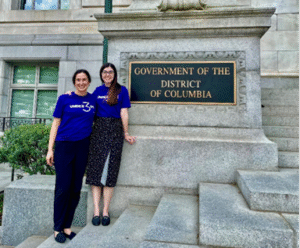
Megan Prior, MD, FAAP & Elizabeth (Libby) Ireson, MD, FAAP at D.C. Council
One program we advocated for preserves funding for child care subsidies for low-income families. In 2024, the average cost of child care in DC was over $23,000 annually for one child. (2) Over 8,000 children currently receive subsidies to attend high-quality child care centers in the district. (2) These subsidies serve infants and toddlers, but also school-age children in need of after-care. The subsidy program uses both local and federal funds and currently does not have a waitlist. Maintaining access to these subsidies is paramount in supporting child well-being. High quality child care improves both health and developmental outcomes, while allowing parents to work and support their families.
Pay Equity Fund & HealthCare4Child care
To maintain high-quality child care options in DC, several innovative strategies have been put in place to strengthen the child care workforce. The average child care worker in the United States is paid just $15 per hour. (3) Consequently, qualified and motivated people hesitate to join the field and those who do tend to exit quickly. Centers struggle to maintain staff.
To address this problem, DC put in place the Pay Equity Fund and the HealthCare4Child care program. The Pay Equity fund uses a tax on high-income earners to fund child care worker salaries. The goal is to achieve parity with public school teachers. A 2024 Mathematica study demonstrated that DC retained 219 or 7% more child care workers after implementation of this program. (4) They estimate a 23% return on investment due to less staff turnover, less absenteeism, and better-quality child care. (4)
The HealthCare4Child care program similarly helps strengthen the child care workforce. Only one-third of full-time early childhood teachers have health insurance through their workplace, lower than the national average of 52% of workers. (5) Over 16% of early childhood workers are uninsured, nearly double the rate of the general population. (5) This number is higher among Black and Hispanic teachers. (5) Implemented in January 2023, the HealthCare4Child care program provides free health insurance premiums through DC Health Link for employees of licensed child care centers. Workers who care for children also need care—it is impossible to pour from an empty cup.
HealthySteps
We also advocated for continued funding for HealthySteps, which integrates early childhood development and perinatal mental health specialists into pediatric primary care clinics. (6) There are over 300 HealthySteps sites across the country, including the clinic where we work.(6) We see the benefits of the HealthySteps program firsthand. For example, HealthySteps served as an anchor for a new mother who was experiencing domestic violence while caring for her newborn. For this mom, our clinic’s HealthySteps maternal mental health specialist became a trusted support person. Thanks to the HealthySteps team’s dedication to this family, the baby’s mom was able to find secure housing and safe child care, all while ensuring her baby received the care and attention he needed to grow into a healthy, bright, inquisitive toddler.
What’s next?
A few days after our DC Council Advocacy Day, Mayor Muriel Bowser released her Fiscal Year 2026 budget including full funding for early childhood programs such as the Pay Equity Fund and child care subsidies. (7)
To stay in touch with Under 3 DC and learn about future early childhood advocacy opportunities, sign-up for their newsletter.
References
- About Us. Under 3 DC. https://under3dc.org/about-us/
- DC OSSE. MODELING THE COST OF CHILD CARE IN THE DISTRICT OF COLUMBIA, 2024. Presented at: July 2024. https://osse.dc.gov/sites/default/files/dc/sites/osse/page_content/attachments/Modeling%20the%20Cost%20of%20Child%20Care%20in%20the%20District%20of%20Columbia%202024.pdf
- Childcare Workers. Bureau of Labor Statistics. https://www.bls.gov/ooh/personal-care-and-service/childcare-workers.htm
- Schochet O. Ongoing Research Continues to Show Positive Labor Market Impacts of a Pioneering Early Childhood Educator Compensation Initiative. Mathematica. https://www.mathematica.org/blogs/positive-labor-market-impacts-of-a-pioneering-early-childhood-educator-compensation-initiative
- Coffey M. Still Underpaid and Unequal – Center for American Progress. https://www.americanprogress.org/article/still-underpaid-and-unequal/
- Wagoner C van. ZERO TO THREE HealthySteps – Early Childhood Development Experts in Pediatrics. HealthySteps. https://www.healthysteps.org/
- Mayor Bowser Ensures Full Funding for PKEEP, Pay Equity, and Child Care Subsidies in FY26 Budget. DC.gov. April 24, 2025. https://mayor.dc.gov/release/mayor-bowser-ensures-full-funding-pkeep-pay-equity-and-child-care-subsidies-fy26-budget
Header image by Aaron Burden on Unsplash
About the author

Elizabeth (Libby) Ireson, MD
General Academic Pediatrics Fellow at Children's National Hospital

Megan Prior, MD, FAAP
Physician at Children's National Hospital

